Rare vinyl pressings · Editorial field guide
First Pressing Claims: Why a “First Edition” Sticker Is Not Enough
Affiliate disclosure: Some marketplace links earn a commission if you buy. Listings are seller descriptions—not independent authentication or proof of value.
Quick answer. A first-pressing sticker is a sales claim unless country, label, catalog and runout evidence point to the actual edition. The practical goal here is country, label, catalog and runout research workflow, while keeping uncertain details visibly uncertain.
This guide is for someone handling specific physical pressing—whether deciding what to buy, documenting a family find, or preparing a defensible sale description. The key is to investigate the exact example rather than relying on a broad category name.
What to establish first
The question: Country, label, catalog and runout research workflow. This is more specific than “Is it rare?” or “Is it worth anything?” because it can be answered from recorded evidence. A first-pressing sticker is a sales claim unless country, label, catalog and runout evidence point to the actual edition.
Before spending time on a valuation, establish which version or condition is actually involved. The practical risk is calling a record a first pressing from the jacket alone, or treating every runout variant as separate and rare. Neither age nor an attractive seller story resolves that uncertainty.
In-depth field guide
For collectible vinyl, “first pressing” is a specific manufacturing claim, not a synonym for “old,” “sealed,” or “sounds great.” Records can have multiple releases within one year, multiple plants, different jackets, and production variants that look almost identical from a distance. A reliable identification starts with the actual object.
Record the easy details first
Write down the artist, title, label, catalog number, country, format, visible copyright information, and whether the copy is mono or stereo. Photograph the front and back jacket, spine, labels on both sides, and any inserts or stickers. For a sealed copy, some of these details are not visible; mark them unknown rather than inventing them.
A hype sticker saying “original” may be part of later packaging. A seller's first-pressing claim should be supported by release-specific details that can be compared to authoritative references.
The runout is often decisive
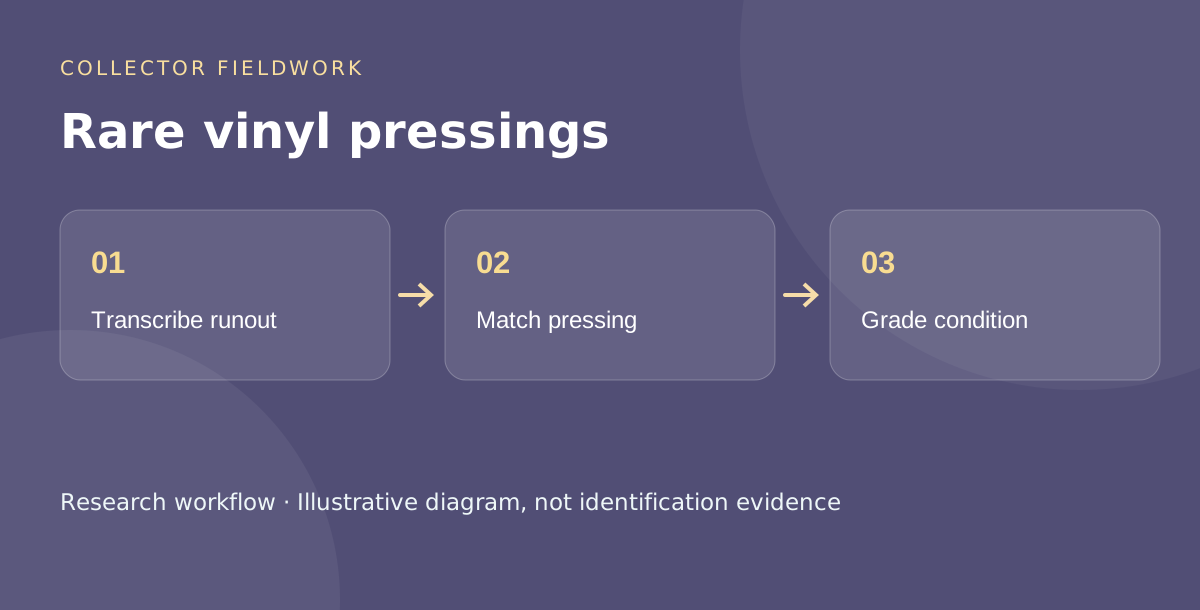
The runout area is the smooth space near the center label, often containing stamped or etched markings. Transcribe the full sequence from both sides, including unusual symbols and spacing as accurately as possible. Discogs' published database guidelines explain that runout information may identify manufacturers, studios or variants—but not every change automatically establishes a separate pressing.
Use a soft light and handle the disc by the edge and labeled center. Avoid dragging the record across a hard surface. Photograph markings when possible rather than relying only on a handwritten transcription.
Match a release, not merely an album
An album's master listing may group dozens of distinct releases. Compare country, label design, catalog number, runout, sleeve and inner sleeve, and distinguishing marks in the release notes. Be cautious with user-contributed database entries. If two entries conflict, seek corroboration from label archives, specialist discographies, manufacturer information, or documented copies.
Do not declare a record the earliest pressing solely because its copyright year is early. Copyright may remain unchanged across subsequent pressings.
Sealed records introduce extra uncertainty
An unopened jacket can preserve condition, but it may conceal the exact disc and runout. Original shrinkwrap can be confused with later rewrapping, and stickers can be moved or replicated. If the identity cannot be checked without opening the record, the price should reflect that uncertainty. A sealed copy described as a guaranteed first pressing deserves especially strong provenance.
Condition still drives the purchase
Confirm whether the record has actually been play-tested. “Looks excellent” is not a sound assessment. Ask about warps, scratches, spindle marks, seam splits, odors, moisture, and warping of the jacket. Use consistent grading conventions and disclose what was inspected. A rare edition in damaged condition is not interchangeable with a clean example in comparable-sales searches.
Research realized transactions
Compare sales of the same release variant and similar condition. Do not mix reissues, promotional copies, mono and stereo variants, or different countries just to increase the sample. When the exact release has few sales, communicate that uncertainty rather than pretending the most exciting listing defines value.
A buyer's seven-line checklist
- Country and label recorded.
- Catalog and format verified.
- Jacket and label photographs obtained.
- Both runout inscriptions matched, or marked unknown if sealed.
- Included inserts, OBI, or promotional markings documented.
- Physical condition and return terms understood.
- Comparable completed sales matched to the exact release where possible.
The best first-pressing purchase is the one you can explain to a second collector without requiring them to trust a sticker.
Create an evidence ladder
Start with what is physically attached to the piece: the printed label, holder, wrapper or handwritten note. Next add original receipts, dated photographs, correspondence and auction records. After that come seller statements and unattributed stories. A convincing narrative is not the same as a demonstrated chain of custody; mark the distinction in the inventory instead of smoothing it over in a listing.
Preserve contradictory evidence. An envelope marked 1935 and a piece that seems later should trigger investigation, not a silent rewrite of either item.
The photographs or records that would settle it
Ask for jacket front/back, spine/catalog, labels both sides, legible runouts and condition. A photograph should be useful for diagnosis rather than just flattering. Save uncropped originals and label the views consistently so a specialist can request an additional angle without losing track of the object.
For First Pressing Claims: Why a “First Edition” Sticker Is Not Enough, a useful listing names the scope of what the seller actually checked: country, label, catalog and runout research workflow. An absent identification detail is different from ordinary cosmetic wear; it can change what object a buyer thinks they are purchasing. Save the seller’s answer beside your own observations.
A comparison worksheet for this exact question
| Question to resolve | Evidence to record | Decision if missing |
|---|---|---|
| Artist, title, catalog number and label | Photograph, catalog reference, seller response or exact observation | Mark as not fully identified; defer valuation. |
| Country and mono/stereo issue | Photograph, catalog reference, seller response or exact observation | Use original photo, label or third-party catalog; ask for a closeup. |
| Runout etchings or stamps on each side | Photograph, catalog reference, seller response or exact observation | Price or sell conservatively; document the uncertainty. |
| Sleeve, obi and insert completeness | Photograph, catalog reference, seller response or exact observation | Seek specialist review if value materially depends on it. |
An illustrative decision—not a market valuation
Suppose two examples are advertised as the same kind of collectible. One provides artist, title, catalog number and label and country and mono/stereo issue; the second uses only the broad category name and a single dramatic photo. The better-documented example is easier to research, return, insure and resell. That does not automatically mean it is worth more. It means fewer important facts are being left to imagination.
Record the exact A-side and B-side runouts in the vinyl pressing comparison sheet. Matrix matches are important clues, not a license to infer condition or rarity.
The non-obvious part
The identifying clue may be nearly invisible. Discogs instructs collectors to study the runout as well as the label and jacket. A highly visible first-pressing sticker is not a substitute for matching an actual edition, and the runout alone does not establish condition. Primary source.
Mistakes to avoid and a safe stopping point
The main trap in this category is calling a record a first pressing from the jacket alone, or treating every runout variant as separate and rare. Before a purchase or alteration, confirm: (1) the identity, (2) physical condition, (3) documentation, and (4) the financial or legal consequence of being wrong. If any one of those is material but cannot be checked, ask for evidence or decline the transaction.
Editorial accuracy boundary: Verify exact release with Discogs and official data. This is a verification requirement, not an assertion that the item under discussion has passed inspection. No unseen object is authenticated, appraised or certified by this guide.
Seller question you can copy into a message
I am researching first pressing claims: why a “first edition” sticker is not enough. Could you show artist, title, catalog number and label and explain country, label, catalog and runout research workflow? Please distinguish what you checked personally from what came from a previous owner or grading label. I would also appreciate your return terms if the identification is incorrect.
The answer should create something you can verify, not merely a reassuring adjective. If a seller gives a precise limitation (for example, “I have not tested specific physical pressing”), record that limitation exactly. It may be honest and useful without proving the condition you need.
Practical questions readers ask
What matters most for first pressing claims: why a “first edition” sticker is not enough?
The first test is artist, title, catalog number and label, followed by country and mono/stereo issue. Those details let you narrow the object down before anyone starts guessing a premium.
What if the listing has too few pictures?
Request an uncropped view that resolves the missing identifying mark or condition question. You can save the listing for later, but do not use its price as a comparable until you know the versions actually match.
Should I repair, clean, open or alter it before asking an expert?
Usually document first. An alteration can remove provenance or condition evidence; fragile items and high-value pieces merit qualified advice. The right treatment depends on material and condition rather than an all-purpose cleaning hack.
Marketplace research after identification
Disclosure: We may earn a commission if you purchase through this eBay link. This does not affect the identification steps or any conclusion above.
Browse relevant eBay listings to inspect — search for “first pressing vinyl LP records.” This is a live search, not a verified offer or completed-sale price. Check the actual listing, seller, legality where relevant, and return terms. For valuations, separately review genuinely comparable sold transactions.
References, research limits and related reading
Discogs vinyl identification guide — official or specialist guidance, not a certificate for the item in this article.
Discogs matrix/runout identification guidelines — compare release variants carefully.
Companion guides in this package (publish these routes together):
- Japanese OBI Strips: Matching the Correct Edition
- White Label Promos: Avoiding False Rarity Claims
- Matrix and Runout Etchings: A Step-by-Step Identification Sheet
Collection and buyer education, not individualized appraisal, authentication, legal or investment advice. We have not physically inspected the collectibles described. Affiliate transactions should be independently verified before publication.